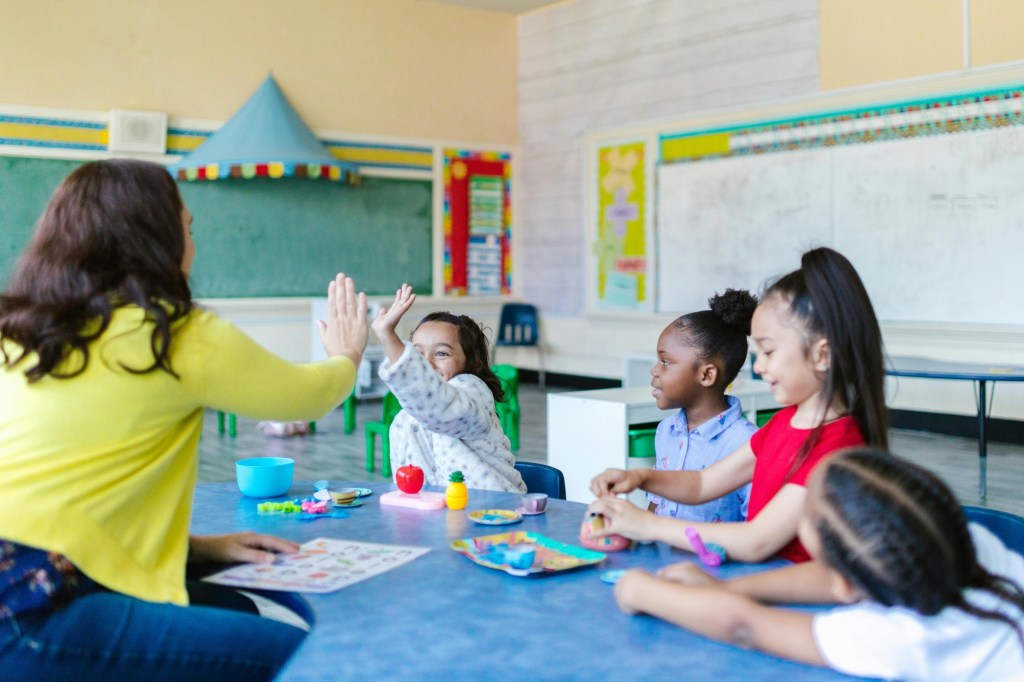
In the United States, we have compulsory public education for children ages 6-18. Many families are eligible for special education services for their child from ages 3-21 under FAPE (free apprpropriate public education law). Many families are eligible for free preschool through Headstart and Early Headstart and other reduced fee preschools based on income and other requirements. These opportunities vary by state. According to the 2019 census statistics, just over 53 million children attend k-12 school in the United States.
Let’s also remember what our “free” education now provides: nurses, OTs, PTs, SLPs, Guidance counselors, social workers, before and after school care, busing to and from school, free breakfast and lunch to those who qualify.
I do not have a problem with any of this.
Transportation, housing, and food insecurity are immediate concerns for any child. If you have ever tried to teach a tired, hungry child who doesn’t know where they are sleeping tonight, you will not begrudge them a nap in your room, a free bowl of cereal, or two extra hours of aftercare.
The problem is, in the three previous paragraphs on education, I did not mention the words teacher, books, paper, pencils, crayons, computers, libraries. If we are going to provide a social safety net for our children from ages 3-21 and make that the focus of our schools, then teachers have become managers not educators. Somewhere along the line, the idea was sold to us that if we rub enough money on it, provide enough programs for it, and then test the heck out of it, we can take care of everybody and teach the kids too. Public school became a business.
Teaching isn’t a business—teaching is a vocation. Teachers go to college to learn how to teach. They do not go to college to learn how to be de facto social workers, nurses, and surrogate parents.
The average day is half gone before a teacher even starts the mandated 90 minute literacy block because of a special program, a student behavior problem, a fire drill, a late bus, or a lockout because of a stranger on campus. No lunch break. No bathroom break. No planning period because there are no substitutes, classroom assistants, or volunteers. Teachers have to cover each others’ classes. This situation is not teaching—it is managing chaos.We ask teachers to do everything but teach, and then punish them for not showing enough academic growth in their students.
I know you’ve heard the lament before America. Boomers will yak about how they had 35 kids in class and no teacher’s aide and everybody behaved. They “got paddled” and teachers had one teacher work day per report period. Sorry Boomers, those days are gone—if they ever really were as great as you remember. Times they are a changing, and we must change too, but into what?
Public education has morphed into a situation that is not sustainable. I’m shocked it has lasted this long! Every year teachers are asked to do more and more that has less and less to do with actual teaching. However, If COVID taught the United States anything, it taught us that teachers and classrooms are not expendable.
As a society, we need to revisit our definitions of teacher, classroom, school function, and education. What specifically do we want to happen from 7:45 to 3:45 every day? Do you want a teacher who teaches, or a warm body in the classroom? Do you want the teacher to teach your children reading, writing, and arithmetic, or do you want a teacher to babysit, feed your children twice a day, and civilize them? There is a real difference between those two end games.
Teaching is a vocation. We love what we do. We like following new ideas of our students. We live for those aha moments in their eyes! We want to establish a relationship with every student, to understand the unique learning style of every student, to provide a dynamic learning environment, and conference with parents on their child’s learning!
“Where your talents and the needs of the world cross; there lies your vocation.”
Aristotle
Teachers have hundreds of children besides our own. We taught you. We taught your parents. We taught your doctor. We taught your boss. We taught your minister, lawyer, home builder, electrician, plumber, bridge builder, ditch digger, restaurant owner, mayor, governor, and even your President. We want to teach your children too.

You’ve heard it said, there’s no such thing as a free lunch. Well, there’s no such thing as a free education either. And in the immortal words of Glennon Doyle, “there is no such thing as other people’s children.”*
Anything worth doing, costs something—your time, your money, your attention, your support. As a society, we need to stop saying “the teachers can do that since the kids are already at school” and start saying, “what can we do to give teachers more time in the classroom to develop our students’ minds?”
Love Y’all, Marla

*Among her many talents, Glennon Doyle is creator of the blog Momastery and co-founder of The Compassion Collective.
 Marla's Alphabet Soup