Usually by this time of year I am readying my Advent wreath, finishing my month long gratitude journal, or simply basking in the glow of having all four of us together for a whole week. This year, I keep waiting for “the moment” but it hasn’t happened—yet. Thanksgiving is later in the calendar. The Christmas push is already on us. And my family togetherness is still two days away. We have been like four ships passing in the night for weeks!
Truthfully, I’ve been floating along on various waves for a while now. I have been known to say, sometimes we just have to by buoyed by others. When we aren’t in a place to fully participate or engage in the hard work of the faithful, it is okay to be carried by others—for a while. I still stand by that thought, but ever since Covid, I have felt my attachments weakening. Without my tribe of the faithful, I have become unmoored. Floating along is not the same as being carried. Floating does not have connection. There is no gravity to give it weight.
That ends today.
I yearn for the gravitational pull of community and commitment. It is time for me to reattach myself to those who have carried me. So I will, and I begin with gratitude. And then I will sing. And I will keep showing up at church with my fellow believers. And that tether will become stronger—not harder or more rigid—but supple and flexible enough to wrap around my heart and center me on the axes of Love of God and Love of Neighbor.
The gravity of gratitude is unfailing. When all else fails, start with a list. In the darkest moment or merely a day of gray, begin with one statement of gratitude. The amount of energy generated with a simple thank you is enormous. When our children are tiny we teach them to say please and thank you. As they grow we ask them to reflect on what they are thankful for. If we are lucky, we will receive unprompted thanks from time to time from them for food and shelter and gas and tuition. Even as they begin to leave home for long periods of time, we sense the gratitude behind the weekly calls and the signs of relief from parental intervention (wanted or unwanted).
Dear ones, as we draw closer to the table—or however you celebrate Thanksgiving—let gravity be your guide. Anchor yourself to thankfulness for small things like your favorite kind of cranberry sauce, or a good weather day so you can escape outside away from the fray, or airpods hidden by your hair, or the knowledge that you don’t have to be here again for 365 days. If this is not the holiday for you, be kind to yourself. If this holiday is for you, use the time to enlarge your heart and store up gratitude for a time when you will need it. Families are complicated. Life is hard. We can rely on the gravity of gratitude for our friends and fellow believers and the kindness of strangers to keep bitterness away.
My friends may be wondering, “where is the blog post about the election?” As much as I enjoy social media and I like to use a blog to share my thoughts, I haven’t been able to summon the energy to write about the election. Whatever I say, someone will make sure that I know, that they know, how ultimately wrong I am to have my own thoughts and feelings. I have read so many articles analyzing this election that my eyes are going to melt. I have heard so much vitriol my ears won’t stop ringing. People who are my friends are yelling at each other, not just on social media, but at social gatherings! People who I find to be normal, kind, people loving people still are spewing forth all kinds of nonsense at one another.
I say, Enough. We had an election. We will have another one in four years. Stop spending your energy in the wrong place. This election was about many different things to many different people. The pendulum of American politics is ever swinging.
Don’t over-simplify the American voters. They can be pragmatists. They can be dogmatists. They can be unaffiliated, party-liners, or single-issue voters. They can be first-time voters or every-time-the-polls-are-open voters. I myself am rather complicated. The American voter is as varied as America itself!
Our elected officials reflect the full spectrum of America from far-left to far-right and all points in between. But the power of the elected official is given by us—not taken from us. Mandate or not, the declared winner of any election becomes the representative for the entire constituency. We have serious work ahead as a nation in holding our leaders in all three branches of government accountable whether elected, appointed by the elected, or confirmed by the elected. The future of our Republic demands we pay attention and fight for it.
Our exchange student went home yesterday. We are all sad, but happy for J and his family to be reunited. Seven weeks is a long time to be away from home.
I found a post I made about my semester abroad on Facebook and I decided to expand it and repost it here. Go see the world y’all. It won’t disappoint you, I promise.
*************************
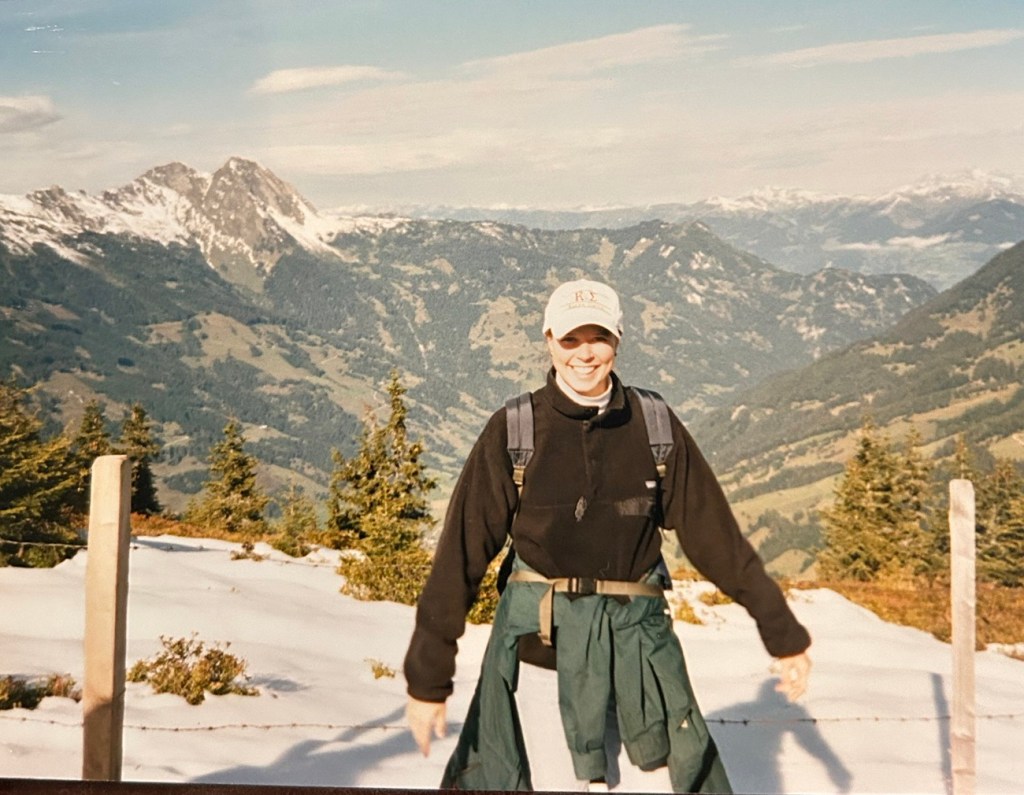
Alpine Marla
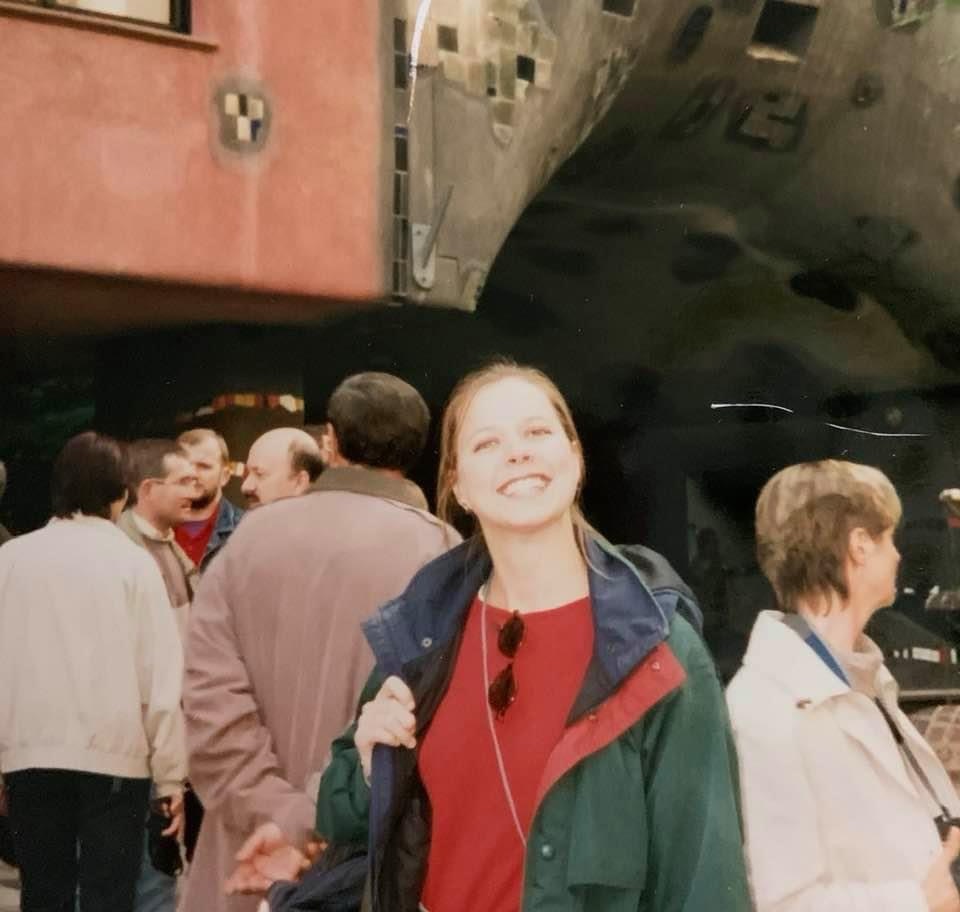
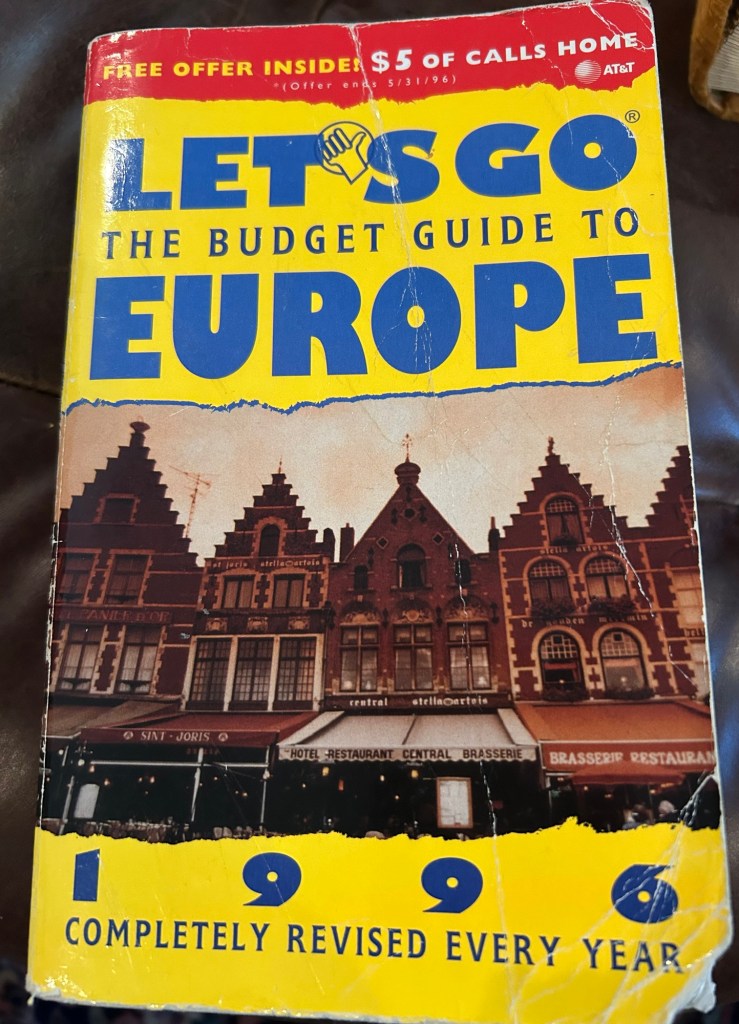
Once upon a time, a long time ago (Fall of 1996), in a country far, far away (Vienna, Austria), a 20 year old Southern American girl took her big friendly smile across the pond determined to take Europe by storm. Well, it didn’t happen quite like that, but smiling helped a great deal. Even with my travel anxiety, I hopped on trains for long weekends and trusted in total strangers and believed that I was mostly immune to danger (other than pick pockets and lecherous, tiresome men, I was). No iphone. No internet. Just pay phones, my Let’s Go Europe Guide, a train schedule, and Jesus. I was braver then.
One thing I learned then that is still true for me today is that people are people and most people are good. I met so many angels unawares. I had the good fortune of always being helped, provided hospitality, or just plain talked to. Everywhere. I have a story for every stop along the way. It sounds rather Bohemian, but I assure you, I’m a safety girl, so I was choosy about my company. Even if we were only pilgrims for a few hours, I always made a friend—in airports, taxis, on trains, buses, in queues, in restaurants, hostels, hotels, and churches. I fell in with random groups of 20-somethings and roamed wherever. Grown up strangers gave warnings, directions, food and shelter. Friends of friends took me in for the day or night just because. I am so thankful that my belief in the goodness of people was affirmed. I still believe it.
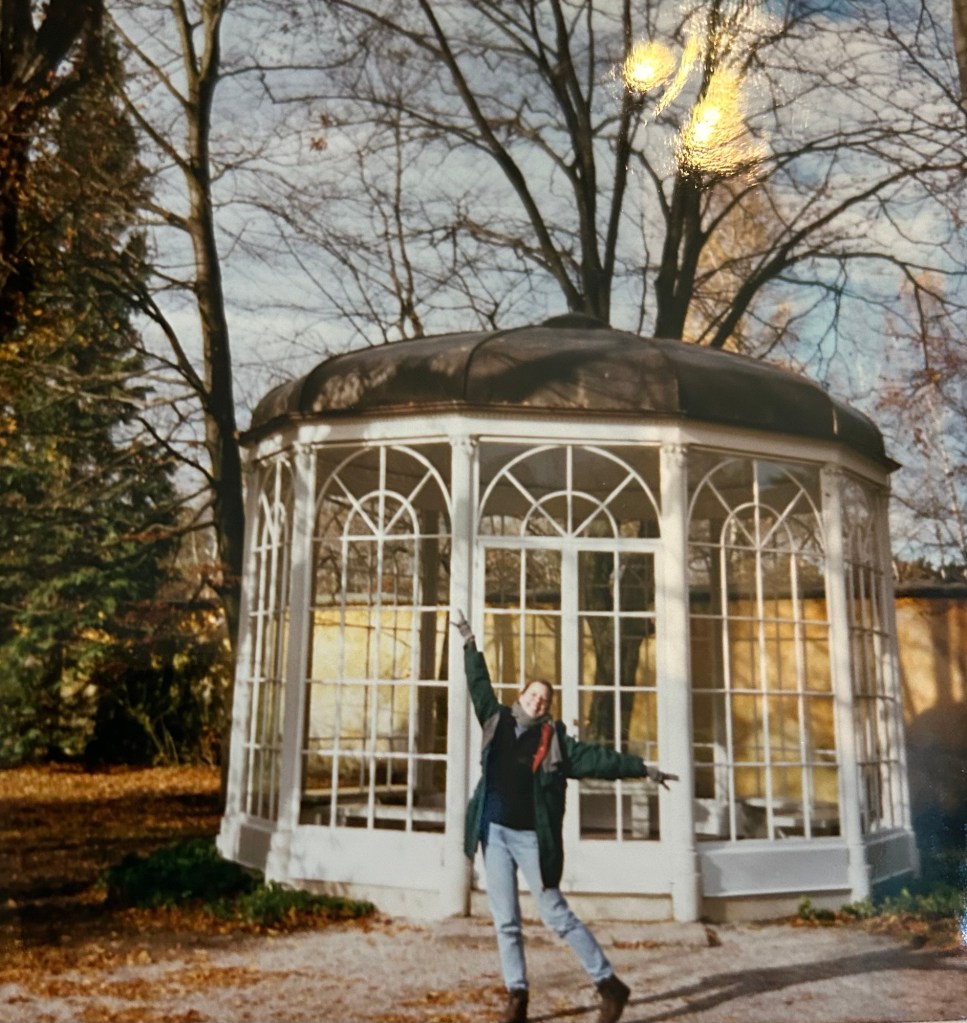
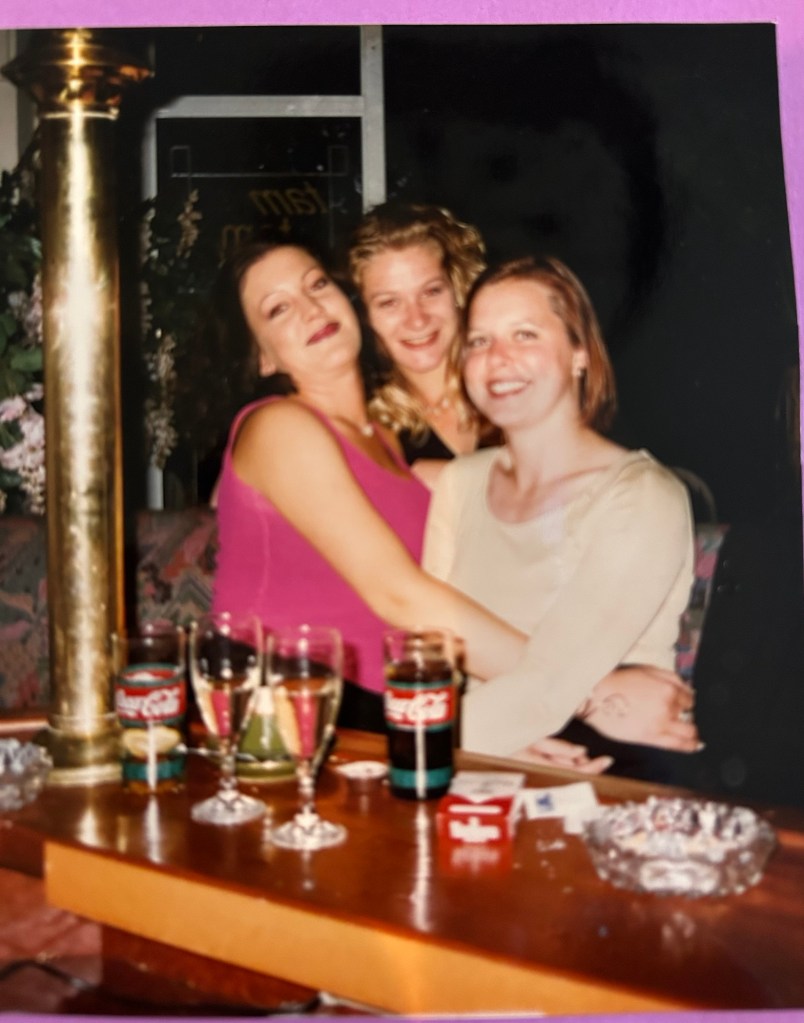
Fun group of gals I joined in Salzburg. I met them randomly in a restaurant. Nobody from my program wanted to go on The Sound of Music Tour with me. I suppose they were afraid I would burst into song.And ofcourse, I did.
The next summer, I moved to Germany to work. Again, so many people loved me through it. I made some good friends who were so very tolerant of me. I do not know where they all are now, but I love them just the same. People and people, and people are good.
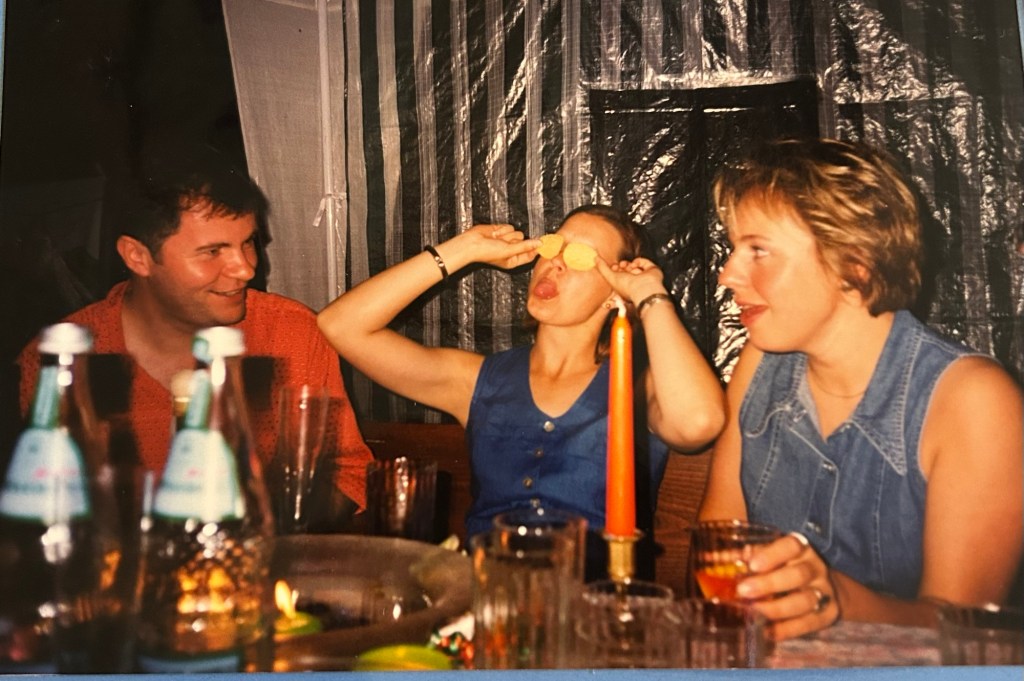
Anna and Britta and Me in Baden-Baden, GermanyWork friends who braved taking me out—once.
Flood, fire, famine, fatigue—the world is a mess. But, if you look for it, you’ll find people just like you going around doing the next right thing, like helping a well-meaning, but clueless stranger in a foreign land find her way.
When I get gloomy about the state of the world, I think of the arrivals gate at Heathrow Airport…. If you look for it, I’ve got a sneaking suspicion— love is actually all around.
Opening monologue from the movie, “Love Actually”.
NYC Skyline at sunset from the Empire State Building
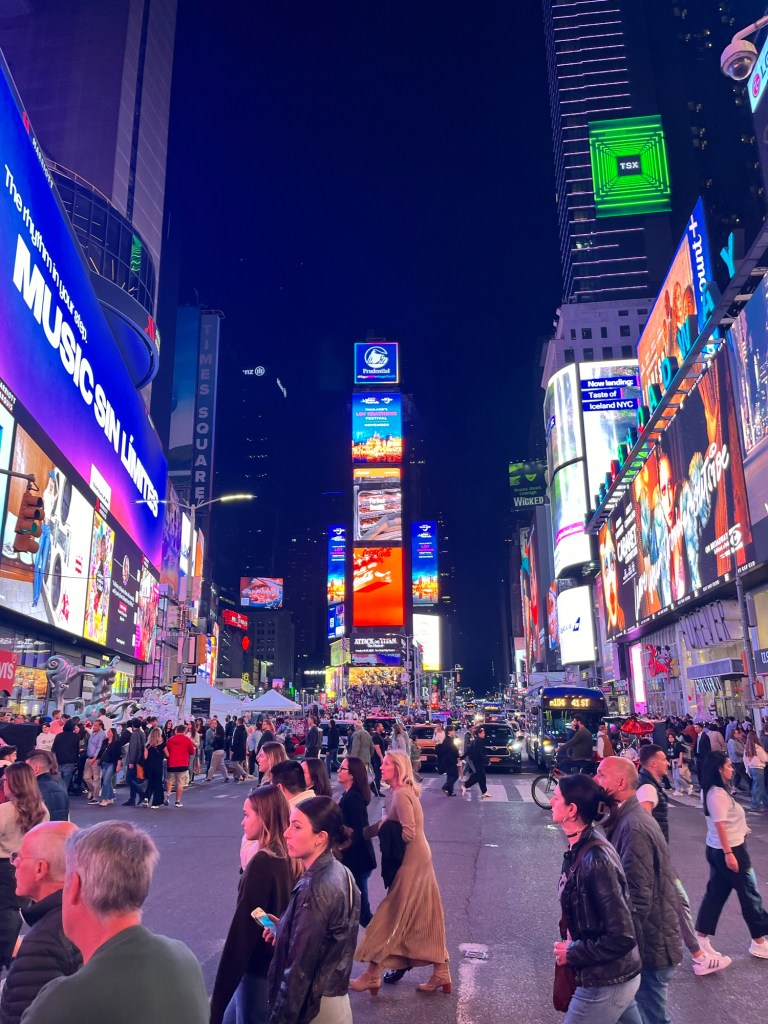
Fall Break 2024. Both of my boys had the same time off and our exchange student J is still here, so off we went to The Big Apple for a quick holiday.
NYC is a bucket list city for almost every person I have ever met. I’m no exception. I love to go to NYC. Every time I go, I feel like I’m experiencing the city for the first time. The city is always changing and even visiting the same areas or points of interest is different every time.
My husband and I try to do something different every time we go to NYC. I remember our first trip to Ellis Island. One year we took the boys to the Tenament Museum. One year we went to the Morgan Library. Once we found the Highline though, we have never missed a quick jaunt to Chelsea Market and Hudson Yards.
Hudson Yards Vessel
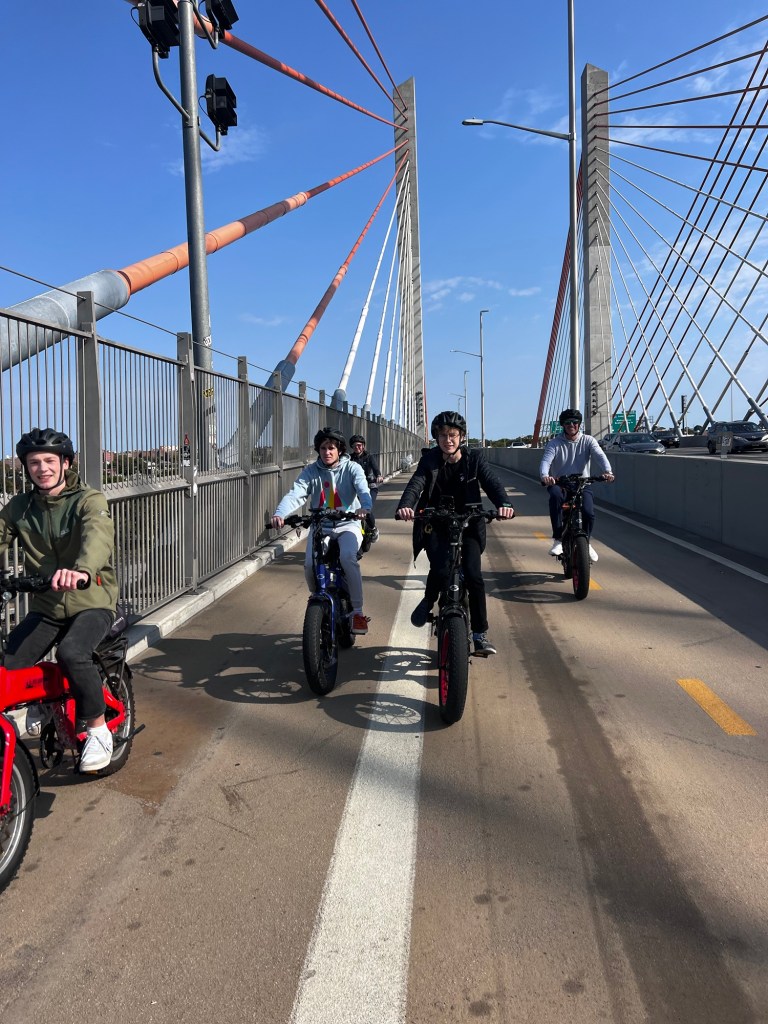
Our one new thing this trip—a bike tour (a very McDaniel thing to do). An e-bike tour of the city bridges: Brooklyn, Manhattan, Williamsburg, Queensboro, and Kosciuszko was the perfect activity for teenaged boys with boundless energy. It was fantastic. Shout out to Rick, our guide. Truly, even for a non-biker with a bad hip like me, it was an unforgettable day!
Best way to see the city!
For those of us who were alive that day, one cannot mention NYC without thinking of 9/11. We visited the Memorial Grounds and walked around the pools. Museum tickets were sold out so we couldn’t visit the museum. J said he had seen several documentaries about 9/11. He didn’t ask any questions. It was the quietest part of our trip.
9/11 Memorial
No trip to NYC is complete without seeing a Broadway Show. I love musical theater. It’s my jam. Some kids play sports. Some kids play instruments. I sing and dance.
I remember my first show in New York. My life was never the same after that night! I left the big city lights determined to go to Julliard and become a theater star or a Rockette. Ofcourse this dream did not happen, but I love a good show and I sing and dance in my kitchen all the time!
This visit was so very special to me because we took J. I loved every minute watching him discover the city. We went everywhere and did as much as we could in 3.5 days. Hopefully, J left the Big Apple with an “Empire State of Mind”.
In New York, Concrete jungle where dreams are made of, Theres nothing you can’t do, Now you’re in New York, these streets will make you feel brand new, the lights will inspire you, lets hear it for New York…. Alicia Keys
Times Square
If you’ve never been to NYC, go! If you have been, go again! “Start spreading the news…I wanna be a part of it, New York, New York…[if you] make it there, you make it anywhere.” Frank Sinatra
For the last month we have hosted an exchange student from Germany. J is delightful. He is enthusiastic about everything and is willing to try anything—any food, any game, any show, any activity. We are having the best time. Watching J have a good experience with America and American school for the first time reminds me of all the positive things about our country.
When my son was in Germany with J’s family, his experience unfolded in a similar fashion. He was mostly enthusiastic about things. He loved the independence and the newness and the differences between Europe and back home. I felt like I was living abroad again for the first time! I was so happy for him. No one can ever take this experience from either young man. Hopefully, they will remember the good for always.
This exchange experience—for us as hosts and for my son being hosted—has made me reflective about first time experiences. I have thought alot about how much I love experiencing things for the first time. The joy of the first time is why I travel, or try new wine, or read a new book, or write a new blog, or try a new anything (mahjong, pilates, pottery class to name a few new ones).
I really, really love watching others experience things for the first time. There is so much joy in it. The expectation. The nervousness. The conquering. Their own realization that they like it (whatever it is). The independence gained. The excitement of discovery. It is all good.
The joy of the first time is also why I teach. My favorite thing about a speech therapy session is the moment “it clicks” for my student. I get so excited when I hear a newly perfected sound for the first time. Or when a student reads a sentence fluently with no errors! The pride and satisfaction in their whole body is the best thing ever!
Interestingly enough, this past Sunday’s sermon was on Revelations 2:1-7 and the “You’ve Lost That Loving Feeling” singing scene from Top Gun. Our minister explained how chapter 2 is a collection of letters to the early churches—the first one being Ephesus. In these letters, John is reminding the church what it felt like the first time they found God through Jesus (i.e. that loving feeling). John then goes on to exhort the church to change their mindsets to get that feeling back, because “you’ve lost that loving feeling.” There was alot more to the sermon and it was certainly more eloquently explained and delivered than this basic recap, but hopefully you see where I’m going with Pastor Dave’s most excellent thoughts!
The point is, I am a seeker of those first time feelings. When my life is not “feeling” like it should, I need to examine what I am doing and make it right. Ofcourse, life isn’t all about feelings. I could use any number of grownup words here: discernment, wonder, hope, duty, love…. If a speech session isn’t going well, tomorrow is another day. I go back to the drawing board and work it out (discernment, hope, faith). If my calendar is too full and I’m filling my life with empty “doings”, I stop and take time to “be” instead (wonder, rest, presence). If I have a disagreement with a friend or my child or my spouse, I try to remember what made our relationship special in the first place and then go and make it right (love, compassion, forgiveness, hope). The joy of those first time feelings centers me within the fruits of the spirit (Galations 5:22-23) and I am closer to the intersection of love of God and love of Neighbor, which is where Jesus wants us to be.
So I encourage you to experience a first sometime soon, whether it is a literal first for you, or you cheer on someone else. Maybe it will reveal something to you—an old feeling or a new one, a fresh perspective, a newfound gentleness, or excitement, or patience, or kindness? Those first time joys bring in the light and the love and the hope we all need to keep our faith in humanity.
Many many moons ago in college I majored in political science. One of my first courses was Feminist Politics. It was an eye opening experience and quite an education about the intricacies of equality and equity for women. I saved my political theory requirement for my senior year. The course was a seminar called Justice and the Welfare State. I learned how difficult it was to put philosophical and theoretical beliefs into practice when faced with the limitations of people and systems. While I am certain these particular political science courses have changed and evolved over time. I am also certain that young not-yet-tax paying twenty-somethings at any institution of higher learning are full of idealism and emotion when wrestling with the greater good and the human condition. I am a middle-aged mother of two, 26 years post undergrad and I still wrestle with the greater good and the human condition.
What does any of this have to do with equity? More than any other courses, these two classes had the greatest impact on my understanding and definition of equity. I thought this prologue helpful to appreciate my arm chair musings on the topic.
************************
Recently listening to a soundbite of a stump speech by Kamala Harris, I was alarmed to hear her say that equity means we want everyone to end up in the same place. Surely she misspoke. I went back and reviewed the extended clips of her speeches. While she never corrected herself, I am fairly certain she meant she wants us all to end up starting at the same place.
Ms. Harris also likened getting ahead in life to a baseball game, explaining that everyone doesn’t start on the same base. Actually, in baseball, if you are in the batting lineup for that game, you get an at bat. Sometimes you strike out and sometimes you hit a homerun. Sometimes the guy in front of you makes the last out so you have to wait until the next inning to get your turn. Just saying.
Perhaps what was meant to be said was, we believe the purpose of equity is to provide necessary support so that access to a successful future is more fair. I really hope so, but I’d like further clarification from the Harris campaign team.
What a person does with appropriate access to the playing field (if you will) cannot be controlled in a free society. Ergo, final outcomes will be different for everyone. The debate about what access to the playing field means is the real conversation about equity. Once upon a time, “all men are created free and equal” upset the apple cart so much so that a new nation was created. Ofcourse “all men” meant white, former European protestants with property and a penis. This country has spent its lifetime broadening the definition of “all men” to mean “all people regardless of sex, race, religion, or national origin. The discussion continues every day.
The United States has tried many forms of equity over the generations—public school, medicaid/CHIP, affirmative action, FMLA, the GI Bill, the post 9/11 GI Bill. Some of these programs worked well and others not so much. All of our current systems are in need of an overhaul. What was designed to work in the 1950s, 80s, or even 2010s does not work so well in 2024. There are serious limitations on the implementation of any policy in a country of our size. Our population is not the same. Our needs are not the same. Systems by nature are designed to be rigid and broadly based in statistical data. There is little room for the characteristics that create differences in people. Governing with any sort of fairness in a country as large and diverse as ours is a challenging, mind boggling undertaking.
There is also the elephant in the room: an unfortunate by-product of equity implementation is us-versus-them thinking. The intersection between what we want for “other”people, what we want for ourselves, and the reality of life is not a neat Venn diagram. It’s more like a wreck in a Nascar race that takes out over half of the drivers. Even with policies meant to level the playing field, variables such as nepotism, optics, likeability, reputation, and plain old fashioned luck cannot be factored out of the equation. The only constant in these types of variables is that they are always present. Now add in the existential concept of what is “enough”. How do we ever define the greater good in a way that is palatable for the majority of Americans?
On page 13 of the Tax Foundation’s Special Report, an article entitled, “The Distribution of Tax and Spending Policies in the United States” from November 2013 Gerald Prante and Scott Hodge write:
“Federal tax and spending policies drive most of the redistribution in America today. The lowest-income families receive $8.13 in federal spending for every $1 dollar they pay in federal taxes. Middle-income families receive $1.57 in federal spending for every $1 they pay in federal taxes. However, high-income families receive $0.25 cents in federal spending for every $1 they pay in federal taxes.
This was five years ago. The top 20% of all income earners paid for 67+% of the country. The diversity and income variation of the top 20% is far greater than one may think. Even among the top 1%, the incomes of the earner at the bottom of that one percent and Warren Buffet or Elon Musk for example are vastly different. I think this is worth mentioning as 1% percenters are lumped together frequently and given a bad rap.
I am not making policy suggestions dear readers. Some form of income redistribution is the only way to make the world work. I am merely thinking out loud and wondering. What is fair? What is enough? What is right? How far do we take the greater good? And who decides? These are not easy questions. Quantifying values statements is messy and emotionally charged.
What we don’t need is more inter- or intra- political party rhetoric. I am all for civil discourse, spirited debate, and displays of passion in the heat of the moment. But the constant railing against the opposition is tiresome and unproductive.
I’ll close with another of my favorite West Wing scenes from 2000-2001. In season two, character Sam Seaborn addresses two political players in his own party:
“Henry, last fall, every time your boss got on the stump and said, “It’s time for the rich to pay their fair share,” I hid under a couch and changed my name. I left Gage Whitney making $400,000 a year, which means I paid 27 times the national average in income tax. I paid my fair share, and the fair share of 26 other people. And I’m happy to, ’cause that’s the only way it’s gonna work. And it’s in my best interest that everybody be able to go to schools and drive on roads. But I don’t get 27 votes on Election Day. The fire department doesn’t come to my house 27 times faster and the water doesn’t come out of my faucet 27 times hotter. The top one percent of wage earners in this country pay for 22 percent of this country. Let’s not call them names while they’re doing it, is all I’m saying.”
Back during COVID I wrote out a prayer for all of us—moms, dads, teachers, kids—about returning to school amidst all the uncertainty of a pandemic. It was a crazy time. None of us knew the day to day much less the week to week plans.
Ready for my sweet students.
Rereading it I realized, the prayer hasn’t changed. New school. New year. New kids. New room. New program, whatever. Every year is just as different.
So to my friends beginning tomorrow, I salute you. To those already back, I’m sorry that your school district feels the need to kill your joy on August 1st. For those of us beginning next week, I’m right there with you. I’m sending one back to college halfway across the country and one starting junior year with all the college testing and AP anxiety included. We will persevere.
Love y’all so big, Marla
August 2020. On my porch at the lake praying for discernment for a heavy year ahead.
Dear God, I lit my citronella candle to call the Holy Spirit this evening. You and Jesus and apostle Paul understand mosquitoes. Send us your Holy Spirit, Lord. Fill us with wisdom, discernment, compassion, kindness. Whether we send our kids to school or keep them home with us, fill us with grace to say, “be at peace with your choice mom and dad.” Whether we go back into the classroom or online as educators, protect our bodies and connect our minds from six feet or sixty miles. Whether we drop babies off at daycare with fear or with relief, be gentle with parents and caregivers. It’s a hard thing to do any day. Help us to remember always, the wisest words Glennon ever spoke, “there is no such thing as other people’s children.” Protect my boys and protect all children everywhere. Convict us to reach out and stand in the waves for parents when they cannot. Bless mothers and fathers everywhere. Our children are your precious gift. You entrust them to our care. Send help to us when we cannot care for them. Grant us the wisdom to accept that help when it comes. We are all your children God, all of us. Every single person we dislike or with whom we disagree. Every single person who wears a mask or doesn’t. Every single soul on this earth is yours God. Send the Holy Spirit Lord, send Help. Awaken in us the inner strength we need to offer mercy and love to one another, because there is no such thing as other people’s children. Amen.
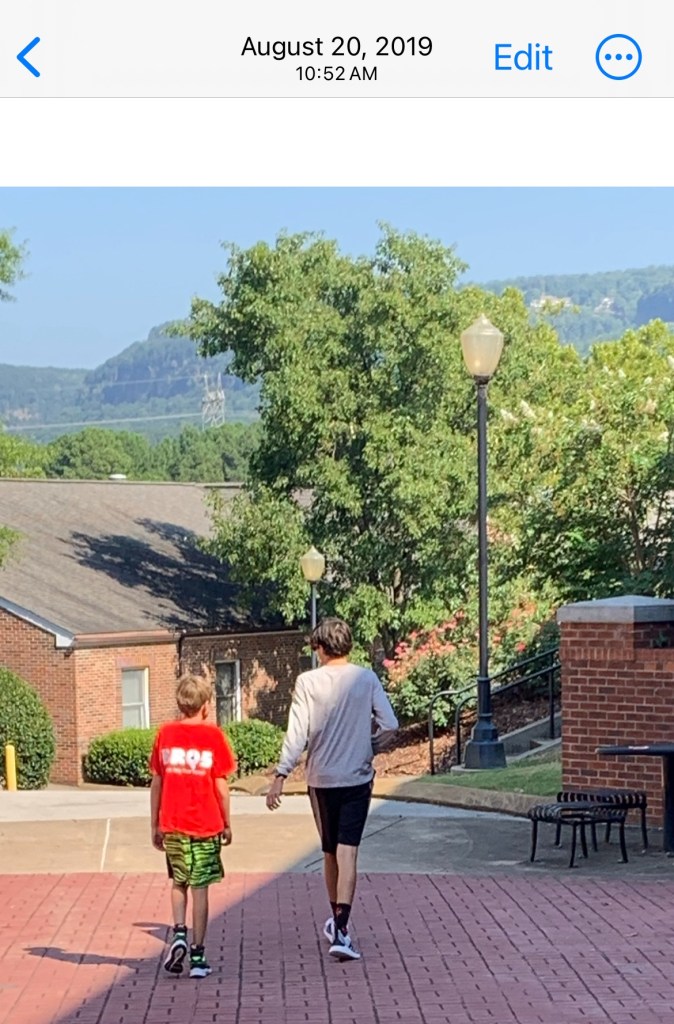
Big high school bro showing little bro the middle school ropes.
Most of my good friends know I have a deep love of the television show, “The West Wing”. It’s brilliant, funny, thoughtful, hopeful, and smart. Aaron Sorkin crafted an amazing script and the cast for this show was second to none. Watch it. You won’t be disappointed, and if you are, well, we can still be friends.
In light of the upcoming election in less than 100 days, I’d like to post the script from one of my favorite episodes of WW here (see it below). I have tried and tried to find the video clip, but I am not nearly as internet savvy as I hoped and then I got tired of searching. The exchange between characters is an excellent reminder to all of us to a) vote, b) remember where we live, and c) be grateful for the American experiment that is a democratic republic.
Win, Lose, or Draw, we’re still America. So go vote America. Whomever you vote for and whatever the reason, that’s for you to decide. We safe guard free speech and the secret ballot so you can go in there and fill in your bubble, or pull the lever, or whatever you do where you vote. Take care America, I’m rooting for us.
Love Y’all, Marla
West Wing, Season Two, Episode Three, by Aaron Sorkin

Sam gets off the phone and out of the car and approaches the stoop.

TOBY
What do you have?

SAM
You're not going to believe it.

C.J.
How'd they go?

SAM
Twelve races, in none of them did the incumbent win. In none of them, did
the party that
previously held the seat win. You know how it went? Seven to five.

JOSH
You're kidding.

C.J.
Seven republicans and five democrats?

SAM
Yeah.

JOSH
The house stayed the same?

Everyone looks at each other.

JOSH
After four months and 400 million dollars, everything stayed the same.

SAM
Yup.

JOSH
Tell me democracy doesn't have a sense of humor. We sit here, we drink this
beer out here
on the stoop, in violation about 47 city ordinances. I don't know, Toby,
it's election night.
What do you say about a government that goes out of its way to protect even
citizens that try
to destroy it?

TOBY
God bless America.

SAM
(beat) God bless America.

C.J.
God bless America.

DONNA
God bless America.

JOSH
God bless America.
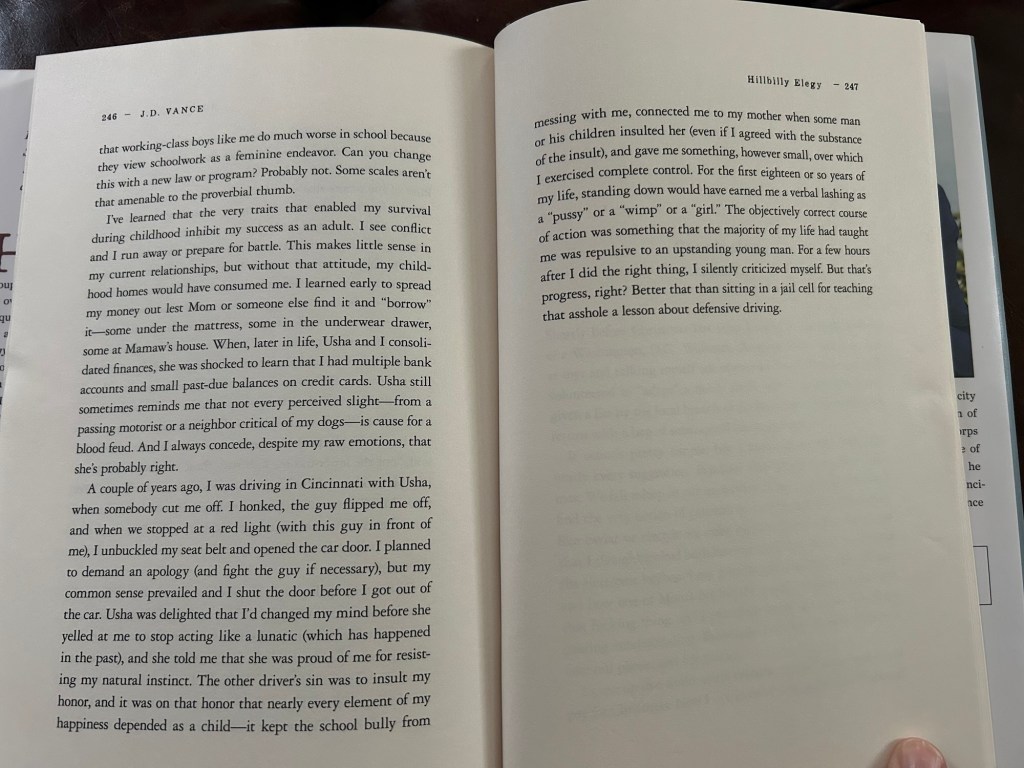
This is not a political statement—and I would appreciate it if we could keep the comments classy. Whether or not you are a fan of JD Vance, it must be said he has a unique life experience unlike any other American politician. I have not experienced these particular life challenges personally. I do however recognize them. As an educator in urban America and a former student in blue collar rural America, I have seen the words on these pages play out time and again.
If you don’t have time to read the whole book, chapter 15 is likely the most insightful. Pages 246-247 below jump out at me. Regardless of the outcome of this election, we must do something for our children. Their knee jerk responses to events and lack of positive decision making as emerging adults is directly related to what we have modeled for them. While we cannot change the family structures of the youth in our lives we can be present as a supportive adult. We can be present as a positive role model. We can be mindful of how and when we speak and always speak in love.