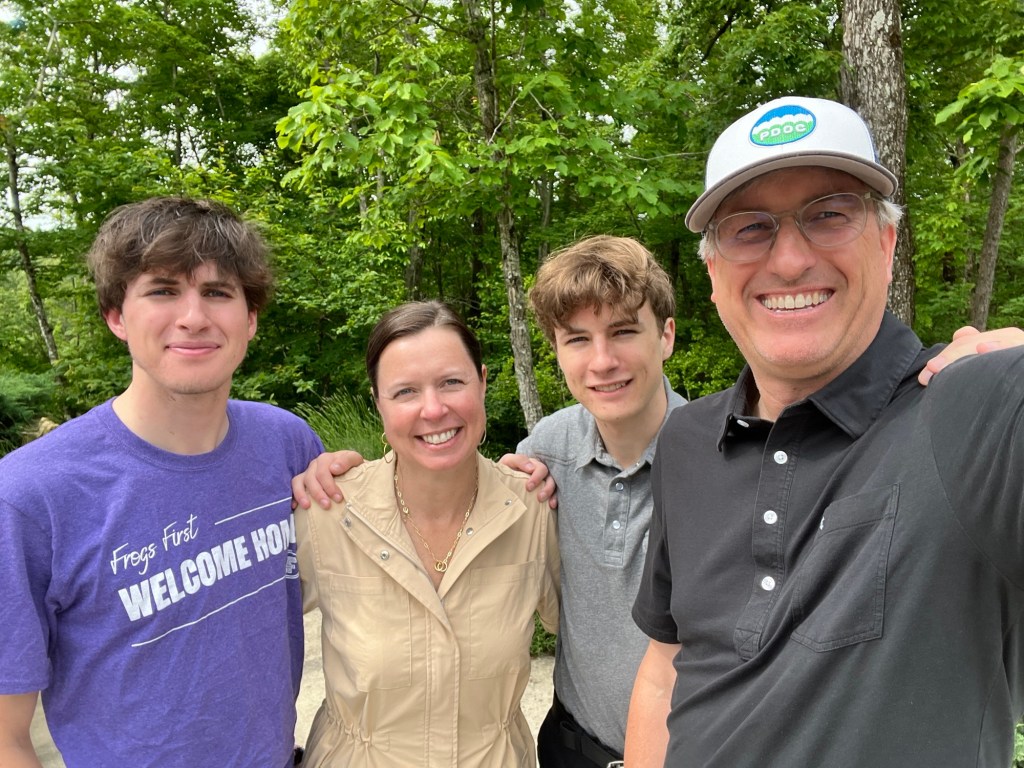
My boys are gone and I am verklempt. There are always big highlights for your high schooler: driver’s license, graduation, off to college. And we have always sent our boys off on summer trips, or summer camps, or family visits without us. This summer is a little different.
My youngest is an exchange student in Germany for half the summer. Today is his first day of school. It’s all in German. As a former college exchange student and summer worker in a foreign country, I am well aware of the language barrier. Go with God buddy. Anne Lamott’s prayer: Thanks, Help, Wow will come in handy.
My oldest left this morning to be a camp counselor for half the summer. This big kid is going to be responsible for other people’s kids. What? Go with God Owen. I know the camp motto is “I am third.” Show them how it’s done.
Meanwhile, back at the ranch, my husband and I are making plans to stay busy so we don’t miss them too much. He has his work of course and his golf. I may have to eat my right hand to keep from texting the boys every day. I took to the bed this past weekend in denial, but I am determined to rally. I am learning to play mahjong and I have joined club pilates. We shall see if it helps. Last night we committed to two date nights a week with the idea of trying as many new or unvisited restaurants in town as we can!
For those who have gone before us, wish us well. For those who are still in the baby weeds, bless you. For those on those blazing hot little league ballfields, I do not miss that at all, but I will toast you with my diet coke from the air conditioned inside.
We chose this. We chose to raise brave, inquisitive, traveling young men with big hearts and open minds. We raised them to launch unafraid. I just hope they remember how to fly back home once in a while. The nest is always open.
Today brings out all the feels for alot of people, self included. And I know we are in a season of let’s make sure we don’t celebrate anything that excludes anyone. So if you are feeling excluded today, I love you. You are seen. Just skip this post.
I think of Mother’s like I think about my Birthday. It’s a day for me. Ironically, both days involve my mother, but I don’t really celebrate her on either day. I celebrate me (Ah, just like an ungrateful offspring, yes?).
While I am more than my boys’ mom, being their mother has taken up the lionshare of my life. There is value in receiving homage. My children have a chance to show compulsory gratitude which I will accept as genuine (Insert chuckle here). I also like to celebrate that I am surviving the challenge (Winky face).
Today will be a day to say thank you to my mother-in-law for raising an amazing man for me to spend my life with. I am so happy he is mine and we created a family together.
Today will be a day to toast from afar my sister and sister-in-law who are in the trenches with me. Raising a mimosa to you amazing mammas! I have five nieces. Dear Lord send manna and money.
Today is a day to high five my girlfriends most with kiddos, some without. Regardless, we mother each other with love and affection and opinion and empathy. Before we were our own selves, we were another woman’s daughter—known or unknown, loved or unloved, difficult or easy—and that leaves marks visible and invisible.
Today will be a day that I acknowledge the range of emotions I have over being a daughter and care taker of my own difficult mother.
Mostly I’m going to celebrate me. My boys are both home. My husband is back from his trip. I am generally healthy. The sun is shining. My roses are blooming. I don’t have to do dishes or cook today, although I’ll probably do laundry since tomorrow is a work and school day.
So Happy Mother’s Day to me and I dare to say, Happy Mother’s Day to you world.
My oldest (a college freshman) and I had a long chat yesterday about the recent and current campus pro-Palestinians protests. It was an enlightening exchange for me to talk with my son in such an adult manner. We debated the limitations on free speech and discussed different institutions’ responses to student protests.
I also asked him if he thought that students were targeting the correct audience in their calls for divestment. What exactly do students think administrators and professors can do other than speak on their behalf? Few if any will walk away from tenure or a secure job position over a political argument. I doubt college staff will stop contributing to their 401ks and pensions regardless of the mutual fund makeup.
Spotlighting a campus imbroglio on a national level does not attract potential students or their parents which decreases incoming tuition which in turn puts a strain on financial resources these same protesting students depend on—day to day operations like housing, dining, student healthcare. In my experience it is trustee boards, former alumni, boosters, and mega-donors who hold financial power at universities.
Our Congressional leaders are the ones who decide to fund wars, military operations, and foreign aid budgets. Are students calling their offices? Are all the students registered to vote in November? Protesting may satisfy the itch in the short term, but voting is the most certain way to affect change in the long run. Why not march on Washington? Take a page from your mothers’ book—The million mom march on gun control and the pink hats protest of Trump made history in this country. The debate is still out on the effectiveness, but the message was sent.
Why not protest companies that invest in military industry directly?
Why not protest on Wall Street for divestment of Israeli interests?
Have the students asked their own parents or benefactors about the investments that provided the money for these incredibly expensive educations?
I understand that a protest on campus is the quickest, most visible and attainable reaction for students. However, if you truly wish to organize a grassroots protest with meaning, you’re going to have to dig a bit deeper my loves. You have to begin somewhere and I applaud you for beginning. Now it’s time to refine your message, eschew violence, and be open to true dialogue and difference. Use the momentum for good.
You can protest without hate. If you are truly protesting violence against others you must refuse violence in your own words and deeds. If you truly care about liberating the people of Palestine you must work towards their divestment of those who use them as human shields in a centuries old conflict and fill the power vaccuum successfully. It hasn’t happened yet, but that doesn’t mean we stop trying. The world is a messy, messy place full of greater good gray areas and uneasy alliances. Sometimes the best we can hope for is change in one person at a time. It seems small and time consuming and insurmountable, but recognizing our shared humanity—the me in you and the you in me—is the only way forward. It doesn’t ever feel like enough, but changing one life, changes the trajectory of an infinite number of future lives.
In the United States, we have compulsory public education for children ages 6-18. Many families are eligible for special education services for their child from ages 3-21 under FAPE (free apprpropriate public education law). Many families are eligible for free preschool through Headstart and Early Headstart and other reduced fee preschools based on income and other requirements. These opportunities vary by state. According to the 2019 census statistics, just over 53 million children attend k-12 school in the United States.
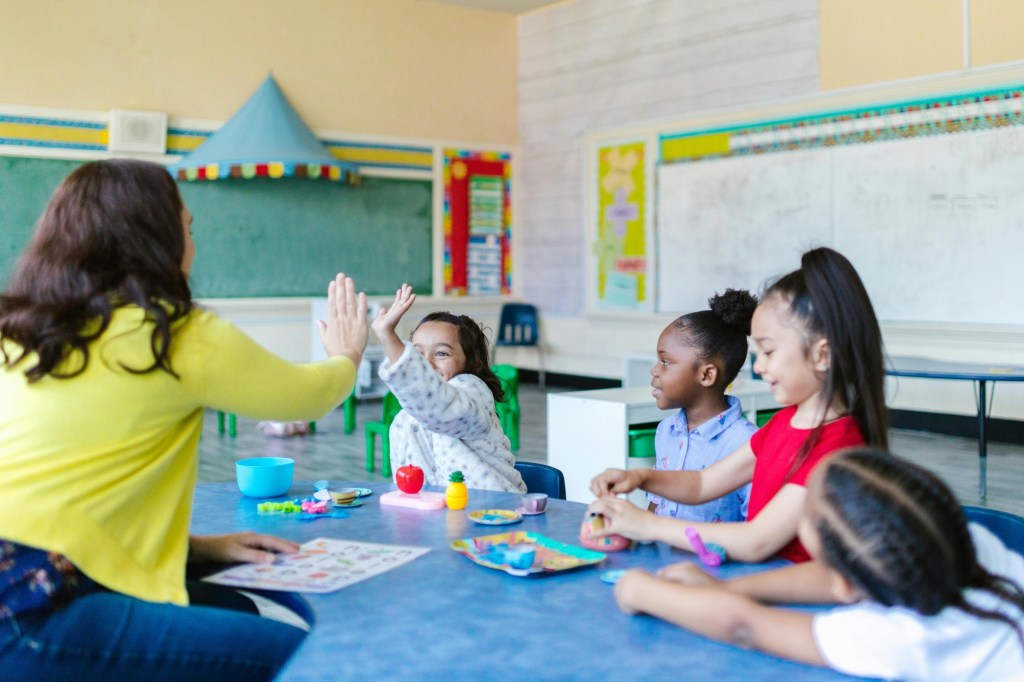
Let’s also remember what our “free” education now provides: nurses, OTs, PTs, SLPs, Guidance counselors, social workers, before and after school care, busing to and from school, free breakfast and lunch to those who qualify.
I do not have a problem with any of this.
Transportation, housing, and food insecurity are immediate concerns for any child. If you have ever tried to teach a tired, hungry child who doesn’t know where they are sleeping tonight, you will not begrudge them a nap in your room, a free bowl of cereal, or two extra hours of aftercare.
The problem is, in the three previous paragraphs on education, I did not mention the words teacher, books, paper, pencils, crayons, computers, libraries. If we are going to provide a social safety net for our children from ages 3-21 and make that the focus of our schools, then teachers have become managers not educators. Somewhere along the line, the idea was sold to us that if we rub enough money on it, provide enough programs for it, and then test the heck out of it, we can take care of everybody and teach the kids too. Public school became a business.
Teaching isn’t a business—teaching is a vocation. Teachers go to college to learn how to teach. They do not go to college to learn how to be de facto social workers, nurses, and surrogate parents.
The average day is half gone before a teacher even starts the mandated 90 minute literacy block because of a special program, a student behavior problem, a fire drill, a late bus, or a lockout because of a stranger on campus. No lunch break. No bathroom break. No planning period because there are no substitutes, classroom assistants, or volunteers. Teachers have to cover each others’ classes. This situation is not teaching—it is managing chaos.We ask teachers to do everything but teach, and then punish them for not showing enough academic growth in their students.
I know you’ve heard the lament before America. Boomers will yak about how they had 35 kids in class and no teacher’s aide and everybody behaved. They “got paddled” and teachers had one teacher work day per report period. Sorry Boomers, those days are gone—if they ever really were as great as you remember. Times they are a changing, and we must change too, but into what?
Public education has morphed into a situation that is not sustainable. I’m shocked it has lasted this long! Every year teachers are asked to do more and more that has less and less to do with actual teaching. However, If COVID taught the United States anything, it taught us that teachers and classrooms are not expendable.
As a society, we need to revisit our definitions of teacher, classroom, school function, and education. What specifically do we want to happen from 7:45 to 3:45 every day? Do you want a teacher who teaches, or a warm body in the classroom? Do you want the teacher to teach your children reading, writing, and arithmetic, or do you want a teacher to babysit, feed your children twice a day, and civilize them? There is a real difference between those two end games.
Teaching is a vocation. We love what we do. We like following new ideas of our students. We live for those aha moments in their eyes! We want to establish a relationship with every student, to understand the unique learning style of every student, to provide a dynamic learning environment, and conference with parents on their child’s learning!
“Where your talents and the needs of the world cross; there lies your vocation.”
Aristotle
Teachers have hundreds of children besides our own. We taught you. We taught your parents. We taught your doctor. We taught your boss. We taught your minister, lawyer, home builder, electrician, plumber, bridge builder, ditch digger, restaurant owner, mayor, governor, and even your President. We want to teach your children too.
You’ve heard it said, there’s no such thing as a free lunch. Well, there’s no such thing as a free education either. And in the immortal words of Glennon Doyle, “there is no such thing as other people’s children.”*
Anything worth doing, costs something—your time, your money, your attention, your support. As a society, we need to stop saying “the teachers can do that since the kids are already at school” and start saying, “what can we do to give teachers more time in the classroom to develop our students’ minds?”
I read an article this week on the lack of college readiness in teens today. I found it disappointing because the focus was mostly on academic preparedness. While I do not doubt much of the article’s lamenting was true, there was little focus on other forms of preparedness. This generation of college bound students have different skills (for better or for worse), different upbringing (for better or worse), different experiences, and different levels of academic preparedness. These differences are out of the students’ hands almost entirely. Did we not have differences between our parents’ generation of college bound students and ourselves? Hmmm.
You know what hasn’t changed? The characteristics of a successful college student. A successful college student has intellectual curiosity, strong metacognitive skills, and good old-fashioned grit.
Unfortunately many of our high school students today have large gaps in these areas. This lack of preparation may increase the likelihood that many students will not complete their degrees regardless of academic prowess. Without these skills life itself will be hard.
Before we say, “well what can colleges do to help them transition?” let’s back up and ask, “what can we do as parents and educators to prepare our children for life after high school ?”
First things first—instill a lifelong love of learning in your child. Love of learning looks like a kid trying something new because it’s different from what they know. It looks like diving deep into a captivating subject. Love of learning looks like an after school enrichment activity, a high school elective, a book club, a chess club, a fishing club, a sport, a community theater, or a karate class. A student doesn’t need all of these at the same time—notice I wrote “or” not “and!” An activity that peaks the interest of your kid enough for them to hold a conversation about it or write a short essay about it indicates a love of learning, a willingness to work, and a coachable, teachable spirit. It also provides them with a hobby or activity for life!
The fuzzy concept known as Metacognitive skills, at its most basic definition, is thinking about your own thinking. How adaptable am I to this teaching style? Do I need to avoid lectures, or at least learn how to deal with them? How much do I need to study? Am I studying in the most efficient way for me? How do I ask for help—and know that I need to ask for help. Can I proofread my own writing? Can I put into words my ideas? How do those words sound to me—and to others? Can I learn to think differently? How well do I organize my room? My backpack? My calendar? My life? In the last dozen years, I have witnessed an alarming decline in a student’s ability to answer and act on these questions about themselves.
I will not point fingers at educators, although there are many ways we can do better. I will say teachers are under enormous pressure for students to perform well on bubble tests and benchmarks set by someone not in their classroom or school. It is difficult for teachers to justify to administrators their decision to take time to teach critical thinking even though critical thinking is what the people in charge say they want! Critical thinking takes time not tests. As educators, we must take the time to teach thinking and application, not just regurgitation. We are developing people not minions. Critical thinking is for everyone, not only the college bound.
I will point fingers at parents, self included (take a breath y’all). Parents are so busy trying to keep their families afloat—whatever that looks like for each family—they spend more hours away from their kids than with their kids. The opportunities for joint attention like family dinner, bedtime reading, playing games, just hanging out and talking happen less and less because joint attention takes time! And time can be a thief. Of energy. Of finances. Of relationships. Of rest. How we as adults choose to spend our time directly impacts our child’s life today and tomorrow.
The things we make important implicitly teach our children what they should make important. This is true whether you have Bill Gates level wealth or you have to stretch every dollar six ways to Sunday. Nobody is perfect. Many of us are still reeling from our own childhood experiences. Sometimes we don’t make the best choices, but we can always make changes! We can intentionally choose our footprint and we can show our children how to cope, adapt, and thrive.
Which brings me to grit.
The idea of grit has always been popular. We love stories about grit. We even make movies about grit—1969 John Wayne and Kim Darby, “True Grit” and the 2010 remake with Jeff Bridges and Hailee Steinfeld for example. Lately grit has been experiencing a revival in pop psychology. There are numerous TedTalks on grit. Books on resilience and perseverance cover the shelves of bookstores and coffee shops nationwide.
Grit is persevering in an action against all odds because of one’s passion for that action or goal. Grit is the willingness to fail and try again. Grit is the ability to self-regulate and stay focused on a task to completion regardless of distractions or obstacles. Grit is intrinsic motivation for personal goals and passions.
What does that look like in a college student?
Grit is the first generation college student who finds support from outside of their family and friends when the relationship dynamics change through no fault of their own. Jealousy, anger, guilt, and codependent behavior from a friend or family member of a first generation college student is real and does happen.
Grit is a college freshman blinking back tears and trying again and again after a professor says that her first paper is crap and she is going to have to do a lot better if she wants to stay in college.
Grit is holding down a day job and going to college at night, or online.
Many of our students today lack this mental toughness. While there are plenty of kids out there getting it done, there are just as many floundering, waiting for the rescue that has always come, or giving up and blaming somebody else. I am honestly not sure how we got to this point, but if our nation is going to make it to the next generation, we have to do better with ALL of our kids!
My opinion on academic readiness is a post for another day, as this post is already way too long. Before we start lamenting the lack of college readiness, let’s talk about what a high school graduate looks like. That’s all for a while. Thanks for sticking with me y’all. You showed true grit in finishing this post!
On Easter Sunday we attended the early service before meeting my inlaws for brunch. While the service was fairly predictable (we Methodists have a penchant for brass quartets and “Easter People Raise Your Voices”), the pastor had a twist on his sermon. He talked about the triumph over the grave and Resurrection as per usual. Then he said, the Resurrection is an illustration of how one’s choices are eternal. Intrigued, I listened as he offered examples. It isn’t that our actual time and resources are eternal (because they are most definitely finite), but the how and who and what we spend our time and resources on are opportunities for eternal impact. Our choices are eternal.
I like this idea very much. I am an educator after all. I have to believe in some small way I will impact the trajectory of a life forever. That is why I do what I do. I may not live to see my efforts come to fruition. I may never see my student again. My student may never remember me. But! If one decision is made based on something I said, or something I taught, that alters the life of my student and their family’s life and their future life for good, then that is a moment of eternal impact. Their future is forever changed.
Not to overstate or add a heavy burden to my already tired dinnertime decision-making, but how my family eats impacts our lifestyle and our health. Whether we have fried chicken or grilled salmon tonight is irrelevant, but the extent to which our resources are spent on food and types of food impact everything from our child’s acne to the cost of our healthcare.
This decision-making power leads me to thoughts about the decision-making power of others—which leads to questions about access to quality food, support for farmers, and our obligation as humans to feed those with food insecurity. If you have ever worked at a food bank sorting food, even one time, it will change the way you donate food to food pantries. You’ll make sure your canned goods have poptops instead of requiring a can opener. You’ll think about donating food you would eat rather than food you don’t want. You’ll include powdered or boxed milk with cereal and or macncheese because you know neither are helpful to have without milk. Your decision of what and how you donate is eternal.
Think about your decisions, just basic ones, and how the smile to a stranger, the good morning to a colleague, the giving up your seat on the subway—-all impact another person in a positive way. Little drops make ripples. Ripples make waves. Waves change the landscape of the earth. Eternity.
I hope this idea of opportunity for “eternal change” changes how I make decisions from now until the end. Your choices are eternal. Make good ones friends.
I celebrated an event on Monday. Since the year of the bicentennial, I have celebrated the day the world was never the same because I entered it!
I love social media on my birthday. I do. I get a day long celebration with texts and messages and posts and pictures from my friends world over. It is fun to be noticed and loved on and showered with positive attention.
However, social media belongs in it’s place. The day after your birthday and suddenly your fb and insta feeds are full of ads for hormone supplements, how to beat menopause, how to work out like a 30 year old, how to look younger, leaner, and feel better. I swear I just deleted all that crap and it’s back again. How about marketing towards clear unaltered skin, strong straight teeth, herbal teas, and cute bifocals? Social media you make me feel bad about myself. How dare you? I’m fine.
How about I celebrate being alive and healthy? Not everyone can say so.
How about I accept that my body parts are exactly as old as they are? I am fortunate to still have them all.
Although I buy into the hoopla surrounding self-care and being kind to yourself, I can go dark in a hurry. I can give in to the negative so quickly. I try not to, but it can be hard. Marketing that preys on insecurities is a big business. It’s everywhere all the time. Sometimes I can’t even have a conversation about what healthy looks and feels like without going down the slippery slope of “I want to look like this.”
So I practice gratitude. I practice liking myself. I make lists (remember I love lists?). I like food. I like wine. I like dessert. I like breakfast. I like walks. I like sunshine. I wear sunscreen. I wear flat shoes. I dress like a teacher. I read books. I try to do new things on occasion. I eat when I’m hungry. I sleep when I’m tired. I plant flowers in the spring. I make peach cobblers in the summer. I dance in the kitchen. And I clean closets to calm my OCD tendencies.
Happy Birthday to me. I have so much more living to do, alot more writing to write, more wisdom to gain, and more experiences to have. Now for one last piece of birthday cake for breakfast!
Love y’all, Marla
A slice of my birthday cake Andy ordered for me! Yum.
We hear a lot about reading, writing, financial literacy, and digital literacy, but what do any of these words mean? According to Merriam-Webster’s online dictionary, the word literate means: an educated person, one who can read and write, a person having knowledge or competence.
UNESCO has a laborious definition for literacy, but the following will suffice for this post. Literacy is: a continuum of learning and proficiency in reading, writing and using numbers throughout life and is part of a larger set of skills, which include digital skills, media literacy, education for sustainable development and global citizenship as well as job-specific skills.
God bless teachers. A teacher welcomes an inquisitive little body into his or her classroom and transforms said wiggle worm into a literate human being with skills to function in the world of reading, writing, math, citizenship, and digital world communications! Teachers are not fairy godparents, but their abilities are mysterious and magical. How do teachers do it? I address the vocation of teaching in another section of my treatise (wink, wink).
As a speech-language pathologist, I work with students on their deficits, disabilities, or difficulties in communication. There is a tension between what is immediately necessary and what the future looks like. If I am doing my job correctly, I am as concerned about a child’s ability to get their needs met in the classroom today, as I am about them passing the driver’s test in 10-12 years. Neither of these milestones has anything to do with the ability to read War and Peace and everything to do with the ability to function in a literate society that depends on the written word and a social structure scaffolded around literacy in all of its forms.
How do we achieve the UNESCO definition of literacy? In my humble opinion, we start by cultivating a love of listening to stories. We once sat around fires and listened to stories. The campfire was the classroom. The instructional value in reading aloud to children cannot be overstated. In today’s classroom, the lack of ability to sit and listen is lamented by preschool and kindergarten teachers nationwide. Notice I didn’t say the ability to sit and do worksheets. I said sit in circle time with other wiggly, distractable humans and listen to someone read aloud a story.
People are not born reading and writing. They must be taught. It’s actually a fascinating process. I could go on and on….
The first step in teaching literacy is to develop an environment that promotes literacy. Is story time valued? Is the newspaper (digital or print) visible in the home? Are there books in the home, classroom, daycare/aftercare? Is time given to just read? Is there a computer or digital device in the home/classroom? Are children and caregivers telling stories and singing songs and reciting nursery rhymes? Are they washing hands to two rounds of the ABC song? Are they sitting around a table or sharing a meal together taking turns telling about their day? Have they been to the public library? Are they playing games that require sequencing steps, remembering items, using numbers or letters, and following directions? It sounds like a lot, but I promise you gentle readers, like I promise my students’ parents, these are things you do or have done at some point in your life every day. In the throws of the daily grind and hustle, we (self included) forget that there is intention learning behind watching caregivers make dinner, doing homework at the kitchen table, playing a game with a sibling, or any daily/evening/weekend routine.
Play is learning for children. We have forgotten how to play as grown ups, but if we bring back story time and mealtime and playtime, we are well on our way to success! We cultivate a spirit of community, listening, participation, and turn-taking when we listen to stories, tell stories, share a meal, play a game. As these basic “pre-literacy” skills are affirmed and established we teachers and caregivers can add next steps—letters, numbers, pictures, and experiences (vocabulary). Children don’t know how to spell McDonalds or Chick-fil-a, but they know the golden arches and the red chicken or spotted cows anywhere! They know what their favorite cereal box or cookie package looks like. A red stop sign in universal. Red. Octagon. White letters. Stop! Children may not know all their letters, but they learn to recognize their name in print.
Experience is the best vocabulary builder. Go to the zoo, the museum, the park, the beach, the lake, a restaurant, the grocery store, the doctor’s office, grandma’s house, on a hike, ride a bus, take the subway, take a taxi. Think of all the words exchanged, recognized, and printed in these exchanges! When we as teachers and interventionists talk about environmental factors or enrichment affecting a child’s learning it is the lack of, or access to life experience with which we are concerned. Schools take field trips and provide PE, music, and art in an effort to level the playing field. Lunchtime, recess, library time are universal environments that all students benefit from. Participation in all of these activities is so important that therapists are almost never allowed to schedule therapy during those times!
Life experience is such a great teacher for students of any age. The first time I had to use a TTY device for my client with the inability to use the phone because of speaking and hearing difficulties was a daunting experience. Taking my mother to the hospital and finding our way through the labyrinth of elevators, hallways that look the same, and indecipherable signage was an eye opening experience. Even a literate, mobile, not-exactly-docile person as myself had enormous difficulty getting us to the right place! Going to the DMV to get a “real id” will certainly convince a person to keep personal papers in order in a fireproof box! The amount of experience and functional literacy expected by others for seemly normal tasks is enormous.
Think about your life and what you do everyday.
Going to the airport…
Using the Uber app…
Ordering a pizza…
Driving to/from home…
Now reflect on what skills were needed to perform those tasks–even minimally. Literacy is so much more than reading “Dick and Jane”.
Stay tuned as I get into the weeds of how a classroom should function versus the daily reality teachers face. It’s dark and daunting, but not insurmountable. Until next time friends.
I originally wrote this post twelve years ago. At the time, I was mentoring teens through a local agency. After defending myself time and again about the upside of abstinence, I decided to write out how I felt and publish it on my old blog. I have updated my original post to reflect personal experience with my own (now) teenagers. I haven’t changed much. And I still make no apologies.
Abstinence is such a no-no word in our culture and I don’t know why. Abstinence is about so much more than “not doing it .” When you teach abstinence you have to explain the concept of self-worth. You can’t just say, “Don’t do X because it’s wrong.”
Believe it or not, as a parent, you’ve been teaching abstinence your child’s entire life. For example, “we don’t say shut up in this house” (we abstain from unkind words) or, “we don’t hit our friends” (we abstain from fighting with our fists) or, “you don’t talk to your mother that way” (we abstain from disrespectful behavior). The list goes on.
I’ve been preaching abstinence to my boys at the dinner table, in the car, during a movie scene, and any embarassing moment I could squeeze in since they were old enough to say, “but mom everybody else….” Abstinence, in a broad sense, is refraining from behaviors or actions with which you don’t agree, or you find harmful or damaging in some way to yourself and others. Abstinence says, “this is who I am, what I stand for, and where my boundaries are.” Abstinence is a lifestyle choice.
As a young adult, I often said crushing things about my own parents. I thought they were unreasonable old meanies who didn’t want me to have any fun. What I didn’t know then, but have appreciated for many years now, is that they gave me the gift of a long youth so that I had time to navigate the murky waters of adult behavior. They gave me the gift of boundaries so that “just saying no” to impaired driving and experimenting with drugs and staying out of the backseats of cars was not as hard as it could have been. They were by no means perfect in this regard (and neither was I), but the message was clear.
To my darling sons and all teens everywhere:
Please don’t think I don’t believe in you. I do. I believe in young love. I actually think love at first sight and high school sweethearts are both real and highly romantic entities. I believe in having fun. I believe in the rush of risk. I don’t find teenagers to be stupid, vapid, shallow, remorseless, or mindless. I think teenagers are feisty, creative, independent, curious, interesting, and sometimes quite charming. I also believe that teenagers are very young, highly inexperienced, prone to impulse, not well-practiced in self-denial, or patience, and occasionally are just plain dumb.
The most reliable way to make sure you have a future is to develop a skillset and find a career path that will enable self sufficiency. Putting yourself at risk of derailing those plans with an unwanted pregnancy, disease, possible addiction, unintended overdose, brain injury or bodily harm is a huge gamble. When you lose, you lose big. Aren’t you worth planning a future for? Who could you be if you thought it was really worth trying for?
To my fellow parents in the foxhole with me:
Talking about abstinence—from sex to seatbelts—is hard. I try to take the long view. Say no now, so that you can yes to so many other things later. I’m not a hypocrite. I acknowledge and explain to my boys tha the rules are slightly different for adults. However, I believe the decisions our kids make under 18 truly affect how they make decisions over 18. The kinder we treat that prefrontal cortex before 25, the kinder life will be to our children.
Why is it socially acceptable to talk about safe sex physically but not emotionally? We as a culture make a huge mistake and thoroughly under-mind our children’s self-worth when we only teach about condoms and birth control as “safer sex.” The concept of safe sex implies sex is inherently unsafe. Wow, what a mixed message to send! Where is the open dialogue to help our kids navigate their feelings and their fears and their questions? Do I support the use of condoms among sexually active people–teenagers or adults? Absolutely. Do I give condoms to my teenage sons with a “just in case buddy” and walk out of the room? Hell no. Do I sit them down at the kitchen table for a long and very uncomfortable talk about the responsibilities and emotional rollercoaster of unzipping their jeans? Every chance I get. Do I tell them that girls might interrupt college dreams and future plans? Yes. Do I try my best to help navigate true loves and false loves and just plain hormones? Yes, yes, yes. Do we talk about all types of birth control and disease? Of course.
Do I preach against any and all drugs? Every single solitary time.
Do I enforce the legal drinking age in our home? You betcha. Do we talk about the dangers of drinking and parties and how to remove one’s self safely if things get out of hand? Yes. Do I talk about their responsibility to their dates at social events? Yes.
Do we have safe words to text when they need help and an understanding that we (mom and dad) are always the first call? Absolutely.
Do I preach about seat belts, speeding, and the perils of social media? All. The. Time.
Am I perfect? No. Do I know these things from experience? Mostly. Do I share my experience? Sometimes. Learning from our choices is part of self-worth too (Forgiving your own youth is a blog post for another day.).
Why do all this heart-wrenching, gut-busting, terrifying, hard to talk about stuff?
Because I believe my sons are worth it. I want them to become masters of their own self-worth. And I believe self-worth begins with abstinence. Abstinence is not a dirty word. It’s not old-fashioned. It’s not frigid, naive, or unhealthy. Abstinence is about believing that you choose the who, what, when, where, why, and how of your behavior—any behavior. Abstinence is about so much more than “not doing it.”
I haven’t forgotten you. I have taken a short break to work on my Education Manifesto. Haha. I am writing a little bit everyday, but have nothing worthy to publish.










 Marla's Alphabet Soup